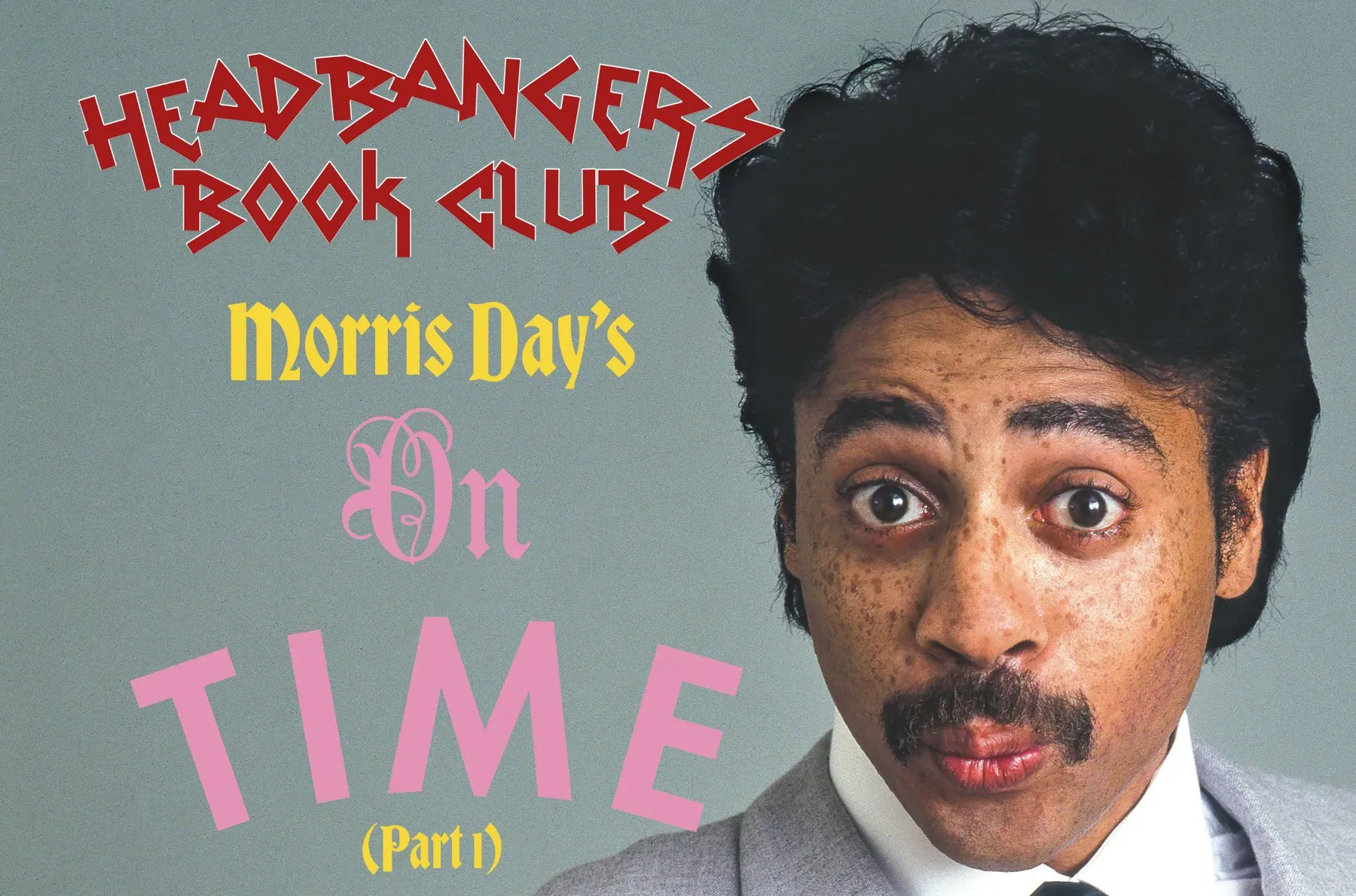
It’s a special #jhericurljune installment of the ol’ Book Club as we dig into 2019’s On Time: A Princely Life in Funk by Morris Day with David Ritz–so, slightly less headbanging than normal, but don’t worry, there’s plenty of the important stuff (i.e., cocaine). We’ll be back in a couple of weeks with Part 2, at which point we’ll also announce our official HBC selection for July. Remember, don’t let us Meat Loaf!
We’ve talked a fair amount about Prince, who would have turned 63 today, as one of the architects of the genre we call Jheri Curl Music: Most notably in our very first Jheri Curl June Special back in 2014, but also in various JCJ entries and profiles on his former colleagues (Sheila E, the Time, Jimmy Jam and Terry Lewis, Vanity, Wendy & Lisa, Jesse Johnson, and André Cymone), rivals (Rick James and, depending on when you ask, at least half of the previous list), and even a few knockoffs (Phil Collins, Ebonee Webb). In fact, we’ve talked so much about Prince on here, you’d be forgiven for wondering if there’s anything else about the Purple One we could possibly have to say (and that’s not even mentioning Zach’s long-running, exhaustively-detailed blog about him).
The thing about Prince, though, is not only is his extant body of work both massive and exceedingly deep, but it’s also constantly growing, as more and more of his music is liberated from his storied Vault. Case in point: his version of “Jungle Love,” a 1984 hit for side project the time after its appearance in the Jheri Curl Cinema landmark Purple Rain, wasn’t even circulating on the robust bootleg market before 2019, when it was released on the posthumous compilation Originals.
“Jungle Love” is actually a Jheri Curl milestone in more ways than one. Aside from being penned by Prince and made famous by the Time, it was also based on an instrumental demo by guitarist Jesse Johnson, whose 1985 “Be Your Man” has the distinction of being the second song ever highlighted for Jheri Curl June. As for the song itself, it’s one of the greasiest of Prince’s early-’80s peak as Jheri Curl progenitor par excellence: an infectious workout driven by a lubricious keyboard line, squelching bass-synth, and rhythm guitar so clean it sounds like it’s still in the shrink wrap. So happy birthday, Prince; here’s to another five years (at least!) of more Jheri Curl gems being unearthed.
We’ll be back tomorrow! Spotify and YouTube playlists below:
So, let’s begin with the elephant in the room. As you might recall, last year the month of June began mere days after the police murder of George Floyd in Minneapolis, which made the idea of a semi-irreverent celebration of dated Black music and hairstyles by two privileged White people feel… tone-deaf, to say the least. It was also, of course, less than three months into a once-in-a-lifetime (knock on wood) global pandemic… long story short, we just weren’t in a party mood. But now it’s a year later; and, while the copsstillhaven’tstopped killing Black people–nor, despite what our respective homestates‘ governors apparently think, is the pandemic over–I think we could all use the mood lift that only the smoothest, silkiest ’80s R&B can provide.
For those of you who are new here (or just need a refresher), “Jheri Curl Music” is our name for a specific brand of glossy, heavily synthesized post-disco R&B music from the early-to-mid ’80s–it’s kind of like our yacht rock, except not even 1% as successful or widely recognized. For details, see our original introduction post from 2014, our 2016 video, or our 2018 podcast. We dedicate each June to celebrating this unsung art form: mostly because “Jheri Curl” and “June” are nicely alliterative, but also because early summer is the perfect time to roll down your windows, let the wind blow through your hair (or, if you’re rocking a J.C. yourself, let it blow kind of against and around your hair), and blast some vintage J.C.M.
This year’s Jheri Curl June is a back-to-basics move for us. There will be no long-form artist/producer retrospectives (like we did for Prince, Michael Jackson, Jimmy Jam and Terry Lewis, L.A. Reid, Jesse Johnson, and André Cymone), no Jheri Curl Cinema features (like we did for Purple Rain, The Last Dragon, Moonwalker, and Coming to America), and no special podcast episodes; just a J.C.M. song every weekday for the whole month, with Spotify and YouTube playlists for your listening pleasure. Still, that doesn’t mean we can’t spend our seventh year stretching the boundaries of what belongs under the J.C.M.-brella. That’s why this year, I’m kicking things off with a possibly controversial choice: Eddy Grant’s 1982 reggae-funk hit “Electric Avenue.”
On the surface, reggae and Jheri Curl Music don’t appear to have much in common, aside from their general origins in the African musical diaspora. Hell, just look at each respective genre’s trademark hairstyle: Jheri curls, as has been well established, are glossy and determinedly non-kinky; meanwhile, Rastafari locs (a.k.a. “dreadlocks”) embrace the organic textures of African hair types. Jheri curls have a well-earned reputation for being synthetic and potentially damaging to Black people’s hair follicles (not to mention their furniture), while locs are (rightfully) celebrated as a “natural” hairstyle and an expression of pan-African pride.
And yet, “Electric Avenue” is proof that even styles as diametrically opposed as these can exist in harmony. Oh, sure, Eddy Grant probably wouldn’t have been caught dead with activator in his hair; but who needs an actual Jheri curl when your keyboards are as moist and juicy as the ones on “Electric Avenue”? Meanwhile, Grant’s lyrics–a righteously angry ode to the 1981 uprisings against racist policing and systemic poverty in Brixton, South London–show that Jheri Curl Music, like reggae, can have a political point of view. As far as this writer is concerned, “Electric Avenue” belongs right next to Paul Laurence‘s “Racism!!!” on any self-respecting J.C.M. protest mix.
Speaking of mixes, below you’ll find Spotify and YouTube playlists for this month’s festivities, which we’ll update with every new track. Unfortunately, the Spotify list is currently empty, as “Electric Avenue” does not appear to be available on the service. We can’t blame Eddy Grant, if this was his choice: a banger like this is worth a lot more than the fraction of a cent a Spotify stream earns. But I think we can all agree that our playlists are a little bit weaker for its absence. See you tomorrow!
It’s a poetic fluke of the cosmos that so many Jheri Curl Music innovators’ birthdays fall in June, the genre’s holiest month. So far, we’ve highlighted Prince (June 7), Jimmy Jam (June 6), L.A. Reid (also June 7), and Jesse Johnson (June 1)–as well as Michael Jackson, who passed away on June 25, 2009. Now, on the occasion of his 60th birthday, it’s finally time to induct André Cymone into the JCM Hall of Fame.
As Prince’s earliest musical collaborator, André Cymone played an integral, but regrettably overshadowed part in the creation of the Jheri Curl Music strain more popularly known as the Minneapolis Sound. On our Prince associates podcast from a couple of years ago, I described Cymone as the twin Prince (figuratively, of course) consumed in utero. So many of the more famous artist’s stylistic choices in the first three years of his career–from his embrace of New Wave sounds and fashions to the whole song “Do Me, Baby”–can be more accurately interpreted as a collaborative effort between himself and his one-time surrogate brother. By the time André, understandably fed up with the lack of credit for his work, went solo in early 1981, the persona known as “Prince” had been more or less fully formed; this inevitably did his longtime partner a disservice by making his solo career look like an imitation.
But today we celebrate André Cymone not as an imitator, but as the innovator he was. While he may not have scaled the critical or commercial heights of his musical other half, his efforts–both behind the scenes and in the spotlight–left an indelible mark on Jheri Curl Music, and on the last 30 years of pop and R&B in general.
We’ve talked a fairamount on this blog about the, ahem, interesting similarities between Rick James’ Mary Jane Girls and Prince’s Vanity 6: a concept James always maintained he came up with first, only for the Paisley Bandit to swoop in and summarily bite it. But if other stories are to be believed, Prince was actually biting from someone much closer to home: his first bass player and one-time surrogate brother, André Cymone.
The rocky relationship between Prince and Cymone is another thing we’ve discussed in Jheri Curl Junes past, and it should be noted that Prince had a history of “borrowing” from his friend and collaborator: “Do Me, Baby,” among other early songs, was by all accounts an André Cymone joint. So it wasn’t exactly a shock to hear that Prince got the idea for a girl group after catching wind of Cymone’s own side project, creatively named “the Girls.” At some point, according to the excellent (and sadly out of print) biography Dance Music Sex Romance, André and Prince even combined their ideas for the group, then known as “the Hookers”; André, however, walked away after realizing that Prince wanted him to do the work without taking any of the credit. And the rest was history: the Hookers became Vanity 6, who became Apollonia 6, and Cymone’s “Girls” released their debut album in 1984, to commercial and critical indifference.
Well, folks, it’s our first-ever Jheri Curl June podcast–and before you ask, yes, we’re talking about Prince again. This time, though, we’re shedding light on a somewhat less-discussed side of his career: the series of (very) thinly-veiled side projects and ghost productions he released in the early-to-mid-1980s under various pseudonyms, most famously “Jamie Starr.” If you’re even an intermediate-level Prince fan, some of these records are essential listening; so settle in, turn up your headphones, and get ready to take a bite of our purple rock.
But first, a word of warning, as I’m afraid there’s a factual error in this one: I was speaking from memory in the section about Sheila E, and incorrectly stated that “Noon Rendezvous” began life as a Revolution outtake. It was actually co-written by Prince and Sheila for the Glamorous Life album; the Revolution just happened to cover it in concert. Oops! Anyway, I left that bit in because I still like the song, so just enjoy the music and try to ignore the fact that I’m blatantly lying to you. Finally, if you like this kind of content (with less inaccuracies), check out my new side hustle: dance / music / sex / romance, a chronological exploration of every (known) song in the Prince oeuvre, which I expect to be updating a couple times a week until it actually kills me.
One of my favorite things about researching and writing for Jheri Curl June is the complex web of connections between the various artists within the genre. Today’s selection, Chicago‘s Jody Watley, is no exception. Naturally, as with most things jheri curl, many roads lead back to Minneapolis: Watley’s 1987 solo debut was co-produced by Prince‘s childhood friend and former bandmate–and, as of this year, JCJ vet in his own right–André Cymone. The other producer on the album? None other than David Z, the older brother of Revolution drummer Bobby, who engineered much of Prince’s work through the mid-1980s.
But Watley is far from just another footnote of the ever-sprawling Prince Dynasty; she’s a part of jheri curl history on her own strengths. She got her start in the late 1970s as a dancer on Soul Train, where legendary host Don Cornelius chose her to join his in-house vocal group Shalamar (more on them next week). And Cymone wasn’t just a producer Watley nabbed for his Minneapolis-Sound cred; the pair were romantically involved, and would later marry for several years beginning in 1989, with a son, Arie, born in 1992.
André Cymone, Prince‘s childhood friend and original touring bass player from ’79 to ’81, is one of a very long list of Prince casualties: including Jheri Curl June veteran (yes, that’s a thing) Jesse Johnson, Mark “Brownmark” Brown, Morris Day, Vanity, and others, all of whom were pissed off at Prince just enough to leave his musical empire and go solo… only to end up making second-rate Prince music on their own, some of which was even written by the Purple One himself. On a side note, it’s eerie that all these people also happened to look like second-rate versions of Prince–with the possible exception of Brownmark, although he could arguably have passed as a chubbier version.
Anyway, before we get too far into diss territory, let me say that Cymone’s 1982 solo debut, Livin’ in the New Wave, is a freakin’ awesome album. Until I heard Livin’ in the New Wave, I had only heard unfinished bootleg versions of the Prince-authored tracks “So Fine” and “Trouble,” which gives it big Prince-nerd appeal. While it’s not a totally groundbreaking album, every song is at the least very listenable, and chock-full of interesting synthesizer blips and harmonies.